The Recipe Is Not a Stopwatch
Learn why recipe cooking time is only a guide, and use texture, appearance, and sound to judge when food is ready without losing your place.
Recipe cooking time is an estimate, not a verdict: the food itself tells you when it is ready. A recipe cooking time may get you close, but a pot of rice, a tray of vegetables, and a pan of fish each respond to heat in ways a clock cannot see.
That difference matters most when conditions shift. A crowded pan warms differently from a sparse one. A thick piece of food takes longer for heat to reach its center than a thin one. Rather than treating the printed minutes as a promise, use them to decide when to begin checking, then read the food’s signals.
Cooking time tells you when to look
A recipe writer has to choose a time that can be printed beside an instruction. In a home kitchen, though, timing changes with the burner, oven, pan material, ingredient size, starting temperature, and even how often the oven door opens. The number is useful as a reference point, but it cannot account for every kitchen.
Think of a stated time as a window for attention. If a recipe says to roast vegetables until tender and browned, begin checking near the end of its suggested range. If the edges are still pale and a fork meets firm resistance, continue cooking and check again after a short interval. If they are already browned and yielding, the clock does not need to overrule your senses.
Keep the recipe nearby, too. Its time can help you notice that something is progressing unusually quickly or slowly. That is a reason to inspect the food and adjust the heat or position if appropriate, not a reason to keep cooking blindly until the printed minute arrives.
Read several cues instead of waiting for one
Readiness is rarely signaled by a single change. Look, listen, smell, and—when safe and suitable—touch or taste. A combination of cues gives you a more reliable judgment than color or time alone.
- Appearance: Look for the change described in the recipe, such as a browned edge, a matte surface, or a sauce that coats a spoon rather than running off immediately.
- Texture: A fork, skewer, or the back of a spoon can reveal whether food is still firm, becoming tender, or starting to fall apart. Use a clean utensil and avoid repeatedly piercing delicate food.
- Sound: A pan may shift from a watery hiss to a steadier sizzle as moisture cooks away. Sound is a clue, not a substitute for checking the food itself.
- Aroma: Freshly cooked aromas can become deeper as ingredients brown. A sharp, acrid smell can signal scorching, so check promptly and lower the heat if needed.
- Resistance: Pressing a piece gently with a utensil can show whether its surface has set or remains soft. For foods where doneness must meet a food-safety standard, use a food thermometer and follow current food-safety guidance.
Not every cue applies to every dish. A clear broth may offer little browning; a crisp cookie may feel soft while hot and firm as it cools. Choose the signals that make sense for the ingredient and the result you want.
Use the clock differently for different foods
Some foods change gradually, so a visual or tactile cue is easy to track. Others can move quickly from ready to overdone. Knowing which pattern you are watching helps you decide how often to check.
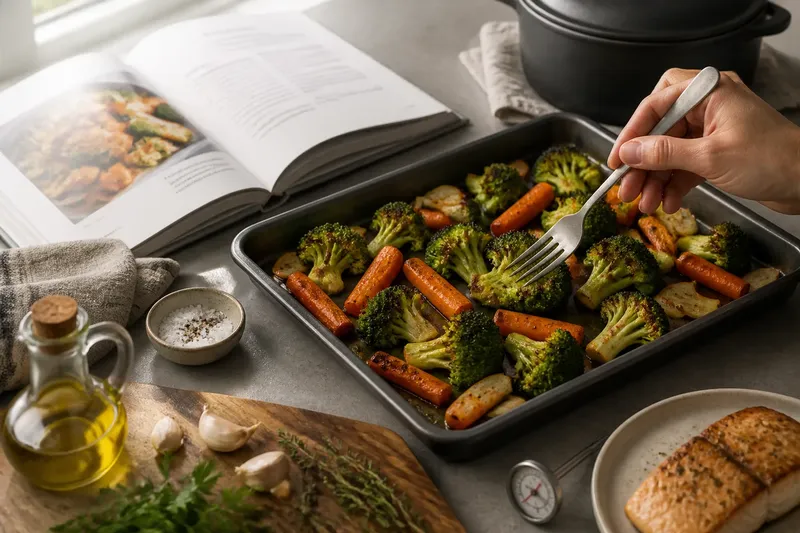
Vegetables: For roasted carrots or potatoes, look for browned surfaces and a skewer that enters with the degree of resistance you prefer. Smaller pieces cook faster than large ones, and pieces that vary in size may not finish together. Remove individual pieces as they reach the texture you want, if that is practical.
Grains and pasta: Water absorption and texture matter more than a timer alone. Taste a piece of pasta near the suggested time, or check whether rice has absorbed its cooking liquid and feels tender. If the texture is still chalky or hard, it needs more time; if it is soft enough, further cooking may make it mushy. For a covered pot, avoid lifting the lid repeatedly, since that interrupts the cooking environment.
Eggs and fish: These can change quickly, and a small difference in thickness can affect timing. Watch for the visual and textural endpoint in the recipe, and use a food thermometer where appropriate for safety. With fish, the thickest part is more informative than a thin tail edge; with eggs, the desired texture depends on how the dish will be served.
Braised dishes and sauces: A long cooking time does not necessarily mean a dish has reached the texture you want. Check whether meat yields easily to a fork or whether a sauce has thickened enough to cling. If the liquid is reducing too quickly while the main ingredient remains firm, lower the heat and add liquid as the recipe allows.
Why the same recipe can take a different amount of time
Ingredients are not identical. A potato cut into uneven chunks will have both tender and firm pieces at the same moment. A chilled ingredient begins at a different temperature from one that has been sitting out. A baking sheet crowded with food traps moisture differently from one with room between pieces.
Equipment adds another layer. A dark metal pan, a ceramic dish, and a heavy cast-iron skillet do not behave alike. Oven settings can also differ from the temperature inside the oven, and a burner’s heat may be less steady than its dial suggests. None of this makes a recipe useless. It explains why checking the food is part of following it.
Say you are roasting broccoli and the recipe gives a time range. Imagine your florets are larger than the ones shown in the recipe and the pan is fairly crowded. Near the range’s later end, you check one thick stem with a fork: it still feels firm, and the florets have not developed the browning you want. You give them more time and check again, expecting the stems to soften and the edges to color; if they begin darkening too quickly, you can move the pan or reduce the heat as the recipe permits. The clock helps you choose when to look, while the broccoli tells you what to do next.
Adjust your checks without turning cooking into guesswork
Frequent checking can be counterproductive. Opening an oven door releases heat; lifting a lid can slow a covered dish; stirring too often may break delicate pieces. Check at sensible intervals, using the recipe’s timing as a prompt, and avoid disturbing the food when the method depends on steady, enclosed heat.
For a pan on the stovetop, checking is often as simple as stirring once, tasting a small portion, or testing a piece with a fork. For baking, use the visual cues named in the recipe and make any skewer test in an inconspicuous place. When you do check, look for a change since the last inspection. That comparison is more useful than asking whether the food looks perfect in isolation.
When a recipe says “until golden,” remember that golden can deepen quickly. When it says “until tender,” decide what tender means for that dish: a crisp-tender green bean differs from a soft one intended for a soup. These words describe an outcome, not a secret fixed duration. If the recipe leaves the endpoint vague, use the dish’s purpose and your own preference to interpret it.
How should you judge doneness when the recipe is vague?
Should I stop when the stated cooking time ends?
Use the stated time as a point to check, then assess the food’s texture, appearance, and other relevant cues. If it has not reached the intended endpoint, continue cooking in short intervals and inspect again.
What if the outside looks ready but the center does not?
Reduce the intensity of the heat if the recipe allows, so the center has more time without the surface darkening too quickly. For foods that require a specific safe internal temperature, check with a food thermometer rather than relying on appearance.
Is taste a useful doneness test?
For foods that are safe to sample and suitable for tasting during cooking, a small taste can reveal seasoning and texture better than sight alone. Do not taste raw or undercooked ingredients that may pose a food-safety risk.
Does food keep cooking after I take it off the heat?
Some foods continue to cook briefly from retained heat, especially when they are thick or held in a hot pan. Account for that carryover if the recipe describes it, and transfer food to a serving dish when you want to slow further cooking.
Build a better feel for your own kitchen
After cooking a familiar dish, note what you observed rather than just changing the recipe’s time. You might record that the vegetables browned before their centers softened, or that the sauce thickened after a brief rest. A short note beside the recipe can help you recognize the same pattern next time without turning a rough estimate into a rigid rule.
Recipes remain useful for proportions, methods, and a sense of sequence. The clock belongs in that same toolkit, but it should not make the decision alone. When you treat recipe cooking time as a cue to inspect and let the food’s texture and appearance guide the final call, you can follow instructions while adapting to the kitchen you actually have.
One small habit makes that judgment easier: check the thickest piece, the largest portion, or the center of the pan rather than the easiest edge to reach. Those spots often tell you more about the dish’s true readiness, and they give you a useful final check before you serve.