The Mortar and Pestle Before the Electric Grinder
Mortar and pestle history reveals how cooks shaped stone, wood, and ceramic tools around local foods, from Mexican molcajetes to Thai curry pastes.
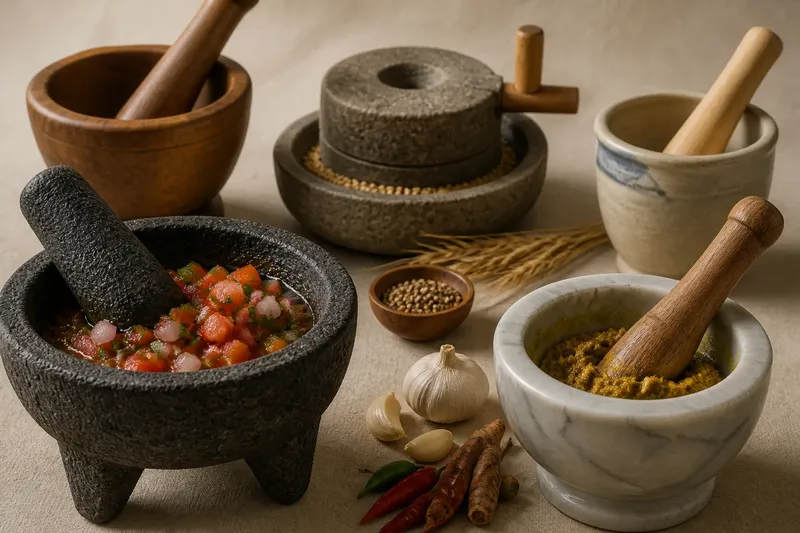
Mortar and pestle history is not a tale of one invention spreading unchanged around the world. It is a record of cooks adapting a bowl and a hand-held tool to particular foods, materials, and motions. A Mexican molcajete used for salsa and a mortar used to pound Thai curry paste belong to distinct kitchen traditions, even though both rely on pressure and friction.
Mortars served more than one kind of work
A mortar is a sturdy vessel; its pestle is shaped to be held and worked inside it. Together, they can crack, crush, mash, or blend ingredients. The cook can strike a hard item, press a soft one against the bowl, or turn the pestle to grind fragments finer.
That flexibility makes the pair useful beyond food preparation, too. Mortars and pestles have been used in many settings for processing different materials. Their forms and materials vary, so it is more accurate to speak of many local histories than to assign every example to a single origin or purpose.
Stone, wood, ceramic, and metal are among the materials used in mortar traditions. The choice reflects both what was available and what the tool needed to do. A heavy bowl can stay steady under force; a wooden tool suits a different feel and motion from a rough stone surface.
Local foods shaped familiar forms
The Mexican molcajete, often carved from volcanic rock, is associated with preparations such as salsa. Its bowl and pestle are part of a specific culinary setting, not merely a regional version of a generic kitchen prop.
In Thai cooking, a sturdy mortar is used to pound ingredients into curry pastes. Pounding breaks and combines ingredients through repeated force. The resulting texture reflects the cook’s motion and the ingredients in the bowl.
These examples show why names, shapes, and customary uses matter. A tool makes more sense when considered alongside the foods and techniques of the kitchen where it is used. Treating all mortars as interchangeable can obscure those differences.
Hand grinding offered a different scale from mills
Hand mortars and larger mills address different tasks. A mill is suited to processing grain or other material in volume. A mortar can serve a small preparation made as needed, where the cook wants to pound or crush ingredients together.
Powered grinders later offered another option for repeated cutting and consistent results. They did not make hand tools obsolete. A mortar still lets the cook adjust pressure and motion while ingredients change, and its role is distinct from that of a mill or electric grinder.
That distinction is more useful than a simple story of old tools being replaced by new ones. Kitchens can keep tools with different strengths, choosing among them according to the ingredient, quantity, and desired texture.
Texture and motion explain the tool’s staying power
A pestle can crack ingredients into rough pieces, grind them finer, or work soft ingredients into a paste. The cook can pause between those stages and decide whether to continue. Unlike a fixed setting, hand pressure changes with the task.
Imagine a cook has mustard seeds and salt for a dressing and wants some visible seed pieces. The cook puts a modest amount in a mortar, presses the pestle until the seeds crack, then checks the mixture. If the pieces still look too large, the cook turns the pestle a little longer; the expected result is a coarse mixture rather than a uniform powder.
The bowl also contains ingredients as they are worked. That practical feature matters when a preparation is small or includes several ingredients meant to be combined. The pestle can press them together in the same vessel, rather than requiring a separate container for each stage.
What questions help explain mortar and pestle history?
Did the mortar and pestle come from one place?
There is no single origin story that accounts for all mortar-and-pestle traditions. Similar forms have been made in different places to process local materials and foods, and their histories should be understood in their own settings.
Why do mortar materials differ?
Materials reflect availability as well as intended use. Stone, wood, ceramic, and metal behave differently under pressure, so a community’s chosen material is part of the tool’s practical and cultural history.
How does a molcajete differ from other mortars?
A molcajete is a Mexican mortar, often carved from volcanic rock and associated with preparations such as salsa. Its name and customary uses connect it to a particular culinary tradition rather than making it a generic substitute for every mortar.
Did electric grinders replace hand mortars?
They offered a different way to process ingredients, especially when repeated cutting or a consistent result was wanted. Hand mortars remained useful for pounding, combining, and adjusting a small preparation through direct pressure.
Read the history through the food being made
Mortar and pestle history becomes clearer when the tool is considered alongside its ingredients and customary motions. A grain mill, a molcajete, and a mortar for curry paste may all process food, but they answer different needs and belong to different practices.
When you encounter a mortar in a cookbook, museum display, or family kitchen, notice what it is made of, how its pestle is shaped, and what preparation it accompanies. Those details offer a more useful account of the tool than the simple claim that it belongs to a vanished era before electric grinders.